- Company size changes the buyer. In a small company the founder may decide. In a large one, a director or department head usually owns the purchase.
- Think committee, not contact. Most purchases involve a budget owner, someone who evaluates the product and someone who feels the problem every day.
- Filter by department and title. Seniority and department narrow a company to the few people worth contacting.
- Verify before you send. The right person with an outdated address is still a bounce.
1. Why reaching the right person matters
Defaulting to the CEO for every account is one of the most common prospecting habits, and one of the least effective. Leadership has the final say on very little day-to-day tooling, while the people who actually own the problem are never contacted.
Reaching the wrong person has two costs:
- Wasted sales time. Follow-ups to a contact with no path to a budget go nowhere, however polite the replies.
- Weaker sender reputation. Messages that are clearly irrelevant to the recipient get ignored or reported, which hurts deliverability for the rest of your campaign.
2. How company size changes who decides
The same product is bought by different people depending on how big the company is. Use headcount as a first guide to which titles to look for. These are rules of thumb, not laws, and your own sales history is the best check.
| Company size | Who usually owns the decision | Where to aim |
|---|---|---|
| Small (under 50 employees) | Founder or CEO, sometimes a single operations lead | Direct outreach to leadership |
| Mid-market (50–500 employees) | Department heads with their own budget | VP of, Head of, Director of |
| Large (500+ employees) | Directors and senior managers who recommend upward | Director, Senior Manager, plus a budget owner |
In larger organizations the person who signs is often not the person who found, tested and championed the product. Reaching only the signer skips the people who shape the decision.
3. Map the buying committee
Most business purchases involve several people. Before you search for contacts, decide which roles you want to reach at each account:
| Role | What they care about | Example titles |
|---|---|---|
| Budget owner | Cost, return and priorities for their department | VP of Sales, Head of Operations |
| Evaluator | Fit, integrations, security and effort to adopt | IT Director, RevOps Manager |
| Daily user | Whether the tool makes their work easier | Sales Manager, Team Lead |
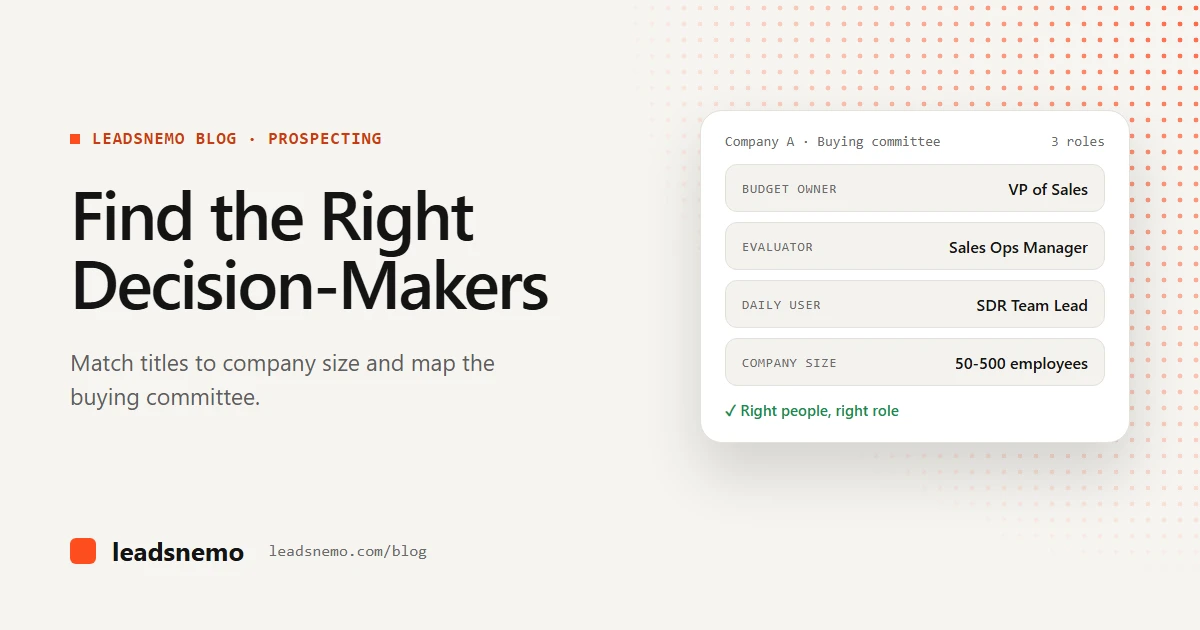
Here is how that might look for one account in a sales-software campaign:
- Account
- Company A · B2B SaaS · 200 employees
- Budget owner
- VP of Sales
- Evaluator
- Sales Operations Manager
- Daily user
- Sales Development Team Lead
- Sequence
- Start with the evaluator, loop in the budget owner
Reaching two or three people at the same company also protects you when one of them changes roles or leaves. A deal that depends on a single contact is fragile.
4. Match job titles to what you sell
Start with the department that feels the problem your product solves, then work out which seniority levels in that department can act on it.
| If you sell | Department | Titles to search for |
|---|---|---|
| Sales intelligence software | Sales | VP of Sales, Head of Sales, Sales Director, RevOps Manager |
| An IT security product | IT and Security | CIO, CTO, CISO, Head of IT, Security Manager |
| A recruiting platform | Human Resources | Head of Talent, HR Director, Recruiting Manager |
| Accounting software | Finance | CFO, Finance Director, Controller |
Titles are inconsistent between companies. A "Head of Growth" at one company does the job of a "VP of Marketing" at another, so search for a family of related titles rather than a single exact match.
5. Filter contacts by department, seniority and title
Once you have a list of target companies, narrow the people at them with three filters, in this order:
- Department. Keep only the team that owns the problem, for example Sales, IT or Finance.
- Seniority. Choose the levels that fit the company size, such as VP, Director or Head of.
- Job title. Add specific titles to remove near-misses from the list.
- Location
- United States
- Department
- Sales
- Seniority
- VP, Director, Head of
- Company size
- 50–500 employees
Review the result before you reveal anything. A few minutes checking that the titles make sense for the companies on your list prevents a lot of mismatched outreach.
People search filters are free to use. You only spend credits when you reveal contact details.
6. Verify before outreach
Senior contacts change jobs, and their details go stale like anyone else's. Verify email addresses before a campaign and remove any that fail. Verification reduces bounces but is not a guarantee of delivery, because mailbox status, sender reputation and recipient-side filtering also play a part.
Right company + right role + verified details
7. How LeadsNemo helps you find decision-makers
LeadsNemo lets you filter people across 150M+ business records by department, job title, seniority, company size, industry and location, and see who matches before you spend anything. A verified corporate email costs 1 credit and a verified direct-dial phone number costs 3 credits. If a revealed email or phone number turns out to be invalid, you can flag it for a credit replacement. See pricing for credit plans.
8. Final checklist
Before you add a contact to your outreach list, ask:
- Does the company size match the seniority level we are targeting?
- Is this person in the department that owns the problem?
- Which role do they play: budget owner, evaluator or daily user?
- Do we have a second contact at the same account?
- Is their email or phone number verified?
- Can we mention something specific to their role or company?
Conclusion
Finding decision-makers is a matching exercise: match titles to company size, match roles to the buying committee and match departments to what you sell. Filter for the few people who matter, verify their details and reach out with a message that fits their role.
Frequently asked questions
How do I find the decision-maker at a company?
Start with the department that owns the problem you solve, then filter by seniority and job title, for example VP, Director or Head of. Adjust the level to the size of the company.
Should I always contact the CEO?
No. At small companies the founder or CEO often decides, but in larger organizations purchases are usually owned by department heads, directors or managers. Contacting them is usually more relevant.
What is a buying committee?
The group of people involved in a purchase, typically a budget owner, someone who evaluates the product and the people who will use it every day.
How many contacts should I reach at one company?
Two or three, in different roles, is a sensible starting point. It keeps the conversation going if one contact is unavailable or changes jobs.
How much does it cost to find decision-makers on LeadsNemo?
Searching and filtering is free. Revealing a verified corporate email costs 1 credit and a verified direct-dial phone number costs 3 credits, and new accounts get 50 free credits. See pricing.