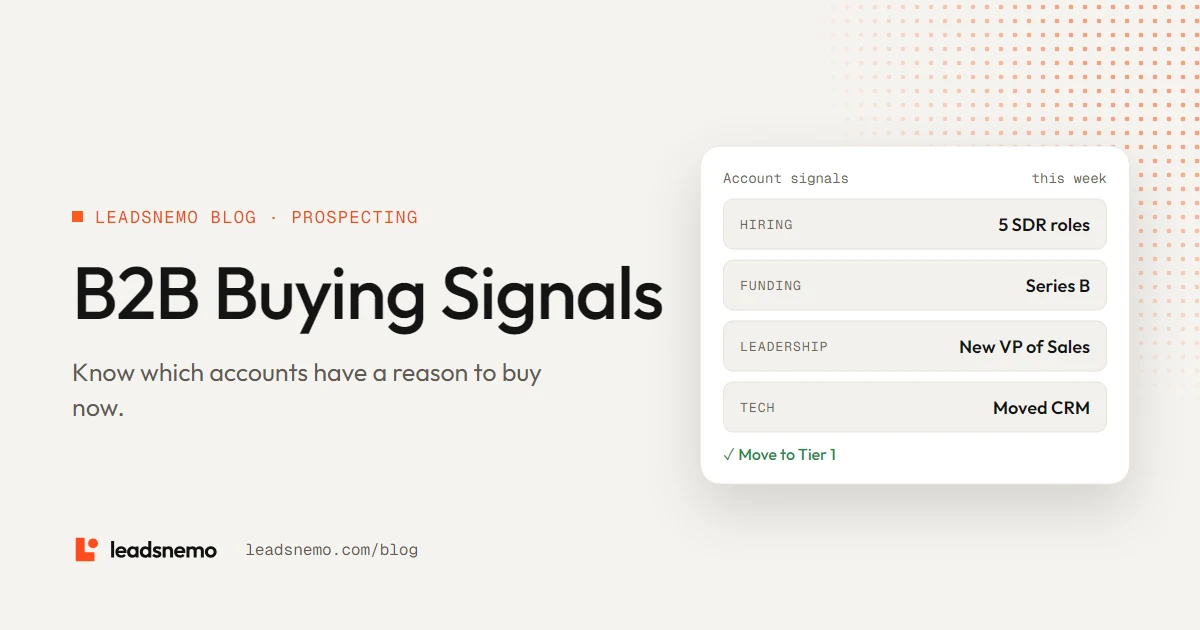
- Signals add timing to fit. Use them to rank accounts that already match your ICP.
- The strongest signals are public: hiring, funding, leadership changes, tech changes and regulatory filings.
- New people are a signal. About one in five U.S. workers started their current job within the past year.
- Reference the event in your outreach, not its private details. Link it to a problem you solve.
1. What are buying signals?
A buying signal is an observable event or behavior that suggests a company is more likely to need your product soon. Signals work on top of fit: they rank accounts that already match your ideal customer profile, and they say little about accounts that do not.
| Type | Source | Examples |
|---|---|---|
| First-party | Your own channels | Pricing page visits, demo requests, webinar attendance, email replies |
| Third-party | Public and data-provider sources | Job postings, funding news, leadership changes, tech changes, filings |
Third-party signals matter because buyers increasingly research alone. Gartner’s 2025 sales survey found that 61% of B2B buyers prefer a rep-free buying experience, so many will never fill in your form before they shortlist vendors.
2. Company-level signals worth tracking
| Signal | What it can mean | Where to find it |
|---|---|---|
| Hiring in a function | New budget or a new process in that team | Careers page, job boards |
| New funding round | Money to spend and pressure to grow | Press releases, funding databases |
| New leader in a department | Fresh priorities and a review of current tools | Announcements, LinkedIn, company news |
| Tech stack change | A migration or a gap the new stack leaves | Website code, job posts, technographic data |
| Expansion | New offices, markets or product lines | Press releases, local news |
| Material corporate events | Acquisitions, leadership changes, restructuring | SEC filings such as Form 8-K |
Public companies leave a reliable trail. According to the SEC’s Investor.gov, Form 8-K is the “current report” companies must file to announce major events that shareholders should know about, generally within four business days. For accounts that file with the SEC, an 8-K is a dated, primary source for acquisitions and leadership changes. For leadership changes, look for Item 5.02, which covers departures and appointments of certain officers (SEC Form 8-K interpretations). Private funding can leave a filing too: a company raising money in an exempt offering must file a Form D notice within 15 days after the first sale of securities.
Hiring is often the clearest signal. A company advertising for five SDRs is building outbound and will need data and tooling. A job post that names a tool also confirms the stack; see how to find companies using a specific technology.
3. Person-level signals: new people, new priorities
People in new roles review tools, budgets and vendors. Job changes are common: the Bureau of Labor Statistics Employee Tenure Summary found that 20.6% of U.S. wage and salary workers had been with their employer for a year or less in January 2026.
- A new leader at a target account may want early wins and be open to change.
- A former customer or champion at a new company already knows your product.
- A promotion can move someone into budget ownership.
Job changes also break your data. When a contact bounces, look for where they went and who replaced them. The data decay guide covers how to keep records current.
4. Score signals so they change priorities
A signal is only useful if it changes what your team does. Give each signal a weight and a time limit, then re-rank accounts every week.
| Signal | Example weight | Stays relevant for |
|---|---|---|
| Demo request or pricing page visit | High | Days |
| New leader in your buying department | High | 3–6 months |
| Funding round | Medium | 3–6 months |
| Hiring in your buying department | Medium | While the roles are open |
| Expansion news | Low to medium | 1–3 months |
Weights here are a starting point. Check them against your own closed-won deals: list the events that happened at those accounts in the 90 days before the first meeting and weight what shows up most.
5. How to act on a signal
- Confirm fit first. A signal at a company outside your ICP is noise.
- Pick the right person. A new VP of Sales is the obvious contact after a sales leadership change; for a funding round, go to the leader of the team you serve.
- Reach out while it is fresh. Most signals lose value within weeks.
- Connect the event to a problem. "Teams that add five SDRs usually hit a data bottleneck in month two" beats "Congrats on the funding".
- Keep it public. Mention announcements and job posts, not details that would feel like surveillance.
Filter by company, department and seniority in LeadsNemo to find who owns the problem. Filtering is free.
Conclusion
Use buying signals to decide when to contact accounts that already fit your ICP. Track hiring, funding, leadership changes, tech changes and filings, give each a weight and an expiry, and reach out quickly with a message that links the event to a problem you solve.
Frequently asked questions
What are B2B buying signals?
Buying signals are observable events, such as hiring, funding, leadership changes or pricing page visits, that suggest a company is more likely to need a product soon.
What is the strongest buying signal?
First-party signals such as a demo request or repeated pricing page visits are usually strongest. Among public signals, a new leader in your buying department and hiring in that department are strong indicators.
How quickly should I act on a buying signal?
Within days for first-party signals and within a few weeks for most public events, since their value fades as the company makes decisions.
Should I mention the signal in my outreach?
Mention public events such as announcements or job posts when they explain why you are writing, and connect them to a specific problem you solve.