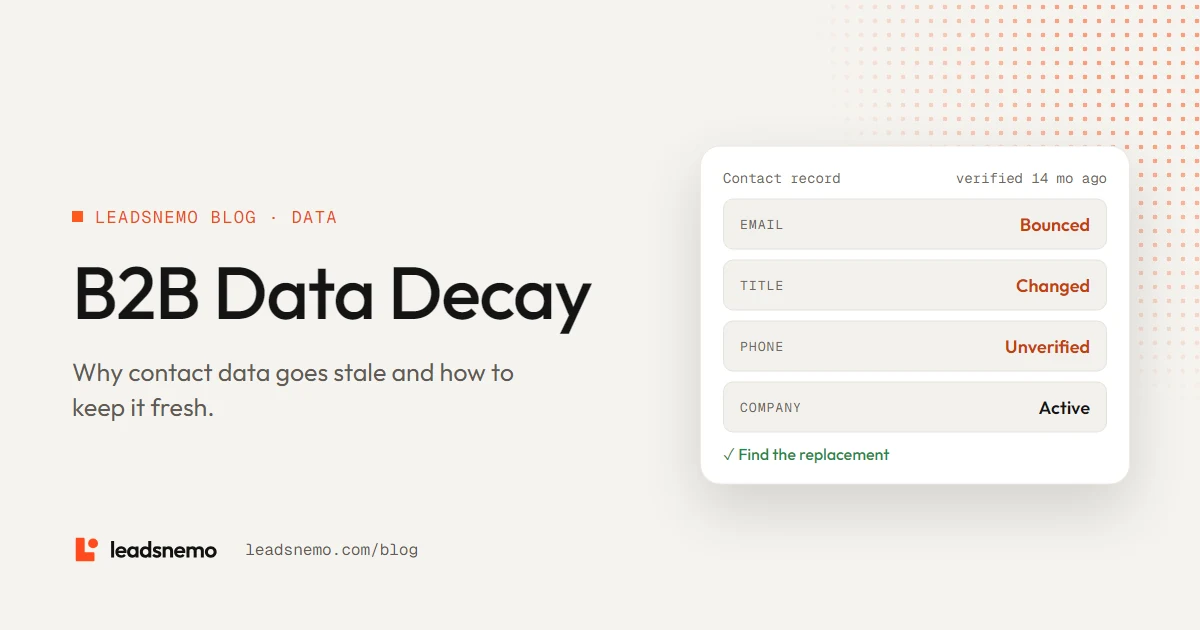
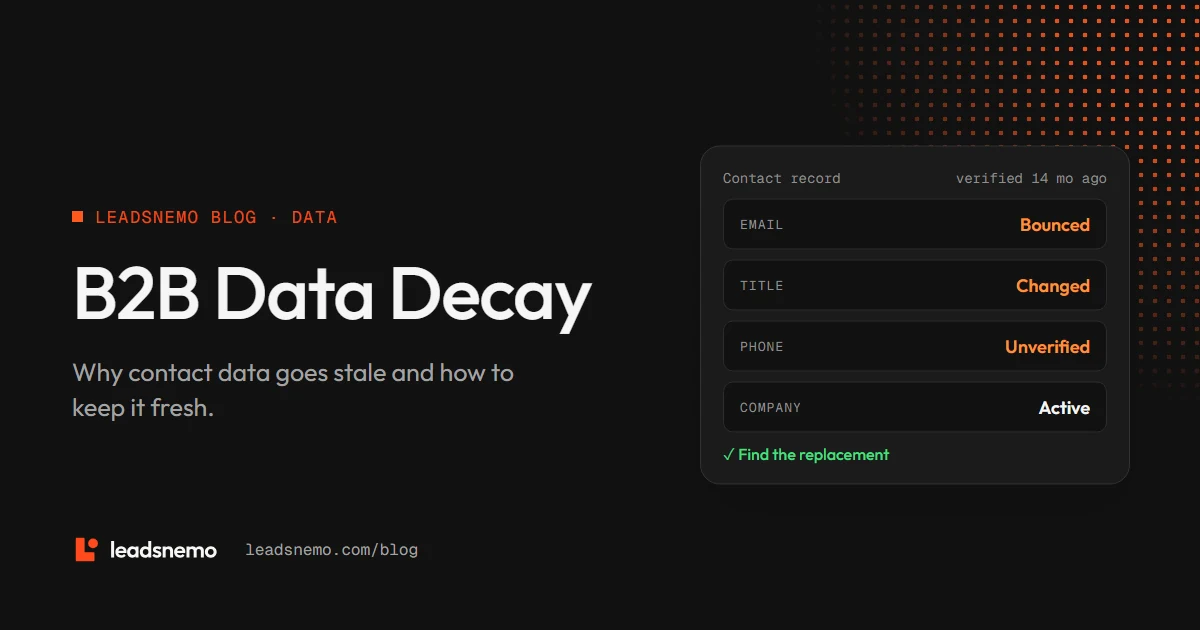
- Job changes drive most decay. In January 2026, 20.6% of U.S. wage and salary workers had been with their employer for a year or less.
- Email and title fail first. Company-level fields such as industry change slowly.
- Measure your own decay rate. Re-verify a random sample and track bounces by list age.
- Refresh on a schedule. Re-verify active lists before every campaign and refresh the CRM at least once a quarter.
1. What is B2B data decay?
B2B data decay is the gradual loss of accuracy in business contact and company records. Nobody has to make a mistake for it to happen. The world changes and the record stays the same.
- People change jobs, so the email address at the old company stops working.
- People change roles, so the title and department on the record are wrong even though the email still works.
- Companies change, through acquisitions, rebrands, new domains, relocations, layoffs and closures. Closing establishments alone cost 1.5 million U.S. jobs in the first quarter of 2026, according to BLS Business Employment Dynamics.
- Phone numbers move, when desks are reassigned or a company switches phone systems. The FCC estimated in 2018 that about 35 million U.S. numbers are disconnected and made available for reassignment each year.
2. How fast does contact data go stale?
The best public evidence comes from job-tenure data. The U.S. Bureau of Labor Statistics Employee Tenure Summary, released in September 2026, reports that the median wage and salary worker had been with their current employer for 4.1 years in January 2026. Tenure is much shorter in some groups.
| Group (January 2026) | Median tenure with current employer |
|---|---|
| All wage and salary workers | 4.1 years |
| Private sector | 3.9 years |
| Workers aged 25 to 34 | 3.0 years |
| Workers aged 55 to 64 | 9.6 years |
The same release found that 20.6% of wage and salary workers had been with their employer for a year or less: about one in five started their current job within the past year. Each of those moves breaks at least one record in somebody’s CRM.
These are U.S. figures for all workers, so treat them as a floor for planning, not a prediction for your list. Lists heavy in younger staff, startups or fast-moving functions such as sales and marketing will decay faster than a list of senior finance leaders at established companies. People keep moving: U.S. employers recorded 5.3 million separations in September 2026, including 3.4 million quits (BLS JOLTS).
3. Which fields decay first
| Field | How fast it changes | Main cause |
|---|---|---|
| Email address | Fast | Job changes, domain changes |
| Job title and department | Fast | Promotions, reorganizations |
| Direct-dial phone | Medium | Desk moves, phone system changes |
| Employee count and revenue | Medium | Growth, layoffs, funding rounds |
| Tech stack | Medium | Tool replacements |
| Industry and headquarters | Slow | Pivots, relocations, acquisitions |
The fast fields are the ones outreach depends on. An out-of-date industry code puts an account in the wrong segment. An out-of-date email bounces, and repeated bounces damage your sender reputation. The bounce rate guide covers that side of the problem.
4. Measure your own decay rate
You do not need an industry benchmark. Two checks tell you how quickly your own data is going stale.
- Track bounces by list age. Tag each list with the date it was built or last verified, then compare hard-bounce rates for lists that are one, three and six months old. The bounce rate guide explains which codes count as hard bounces.
- Re-verify a sample. Pick 200 random CRM contacts each quarter, re-verify the email and check the title. The share that fails is your quarterly decay rate.
- Contacts sampled
- 200
- Email failed verification
- 9
- Title or department changed
- 14
- Records needing an update
- 23 (11.5%)
5. A refresh routine that keeps data usable
| Data set | When to refresh |
|---|---|
| List for an upcoming campaign | Re-verify right before the first send |
| Active pipeline contacts | Check before each new sequence or meeting |
| Full CRM | Sample monthly, refresh at least quarterly |
| Closed-lost and dormant accounts | Refresh before you re-engage them |
- Record the source and date on every contact so you know which records are oldest. Lead enrichment shows how to keep that provenance when you add fields.
- Treat a hard bounce as a job-change signal. Find who replaced the person instead of just deleting the record.
- Follow people who move. A champion who joins a new company is a warm lead at an account you may not have worked yet.
- Archive, do not hoard. Records that fail verification twice should leave your active lists.
Keeping data current is also a compliance point. Under the GDPR accuracy principle in Article 5(1)(d), personal data must be accurate and, where necessary, kept up to date, and inaccurate data should be erased or corrected without delay.
6. How LeadsNemo helps
When you find a stale record, search LeadsNemo for the company and filter by department and title to find the current person in the role. Verified corporate emails cost 1 credit to reveal, and you can flag an invalid email or phone number for a credit replacement.
Find who holds the role now. Filtering is free, and new accounts get 50 free credits.
Conclusion
B2B data decays because people and companies change, and BLS tenure figures show how often that happens. Measure your own rate with bounce tracking and quarterly samples, re-verify lists right before you use them, and treat bounces and job changes as signals to update the record.
Frequently asked questions
What is B2B data decay?
B2B data decay is the loss of accuracy in business contact and company records over time, caused mainly by job changes, role changes and changes at the company itself.
How quickly does B2B contact data go out of date?
It depends on the list. As a reference point, the Bureau of Labor Statistics reported that 20.6% of U.S. wage and salary workers had been with their employer for a year or less in January 2026, so a meaningful share of any contact list changes every year.
How often should I clean my CRM?
Re-verify any list right before a campaign, sample the CRM monthly and refresh it fully at least once a quarter.
Which contact fields go stale fastest?
Email addresses and job titles, because they change whenever someone switches employer or role. Industry and headquarters change slowly.