- An ICP describes companies, a persona describes people. You need both, but the ICP comes first.
- Start from closed-won data. Your best current customers tell you more than a whiteboard session.
- Keep it to five to seven attributes. Industry, size, revenue, location, technology and one or two growth signals cover most B2B sales.
- Tier accounts by fit. A Tier 1 account matches every attribute and gets a rep. A Tier 3 account goes into automated nurture.
1. What is an ideal customer profile?
An ideal customer profile (ICP) is a short description of the type of company that gets the most value from your product and returns the most value to you. Those companies buy faster, stay longer and expand their contracts. The ICP describes organizations. The people you contact inside them are described by buyer personas.
| Ideal customer profile | Buyer persona | |
|---|---|---|
| Describes | A company | A person inside that company |
| Typical fields | Industry, employee count, revenue, location, tech stack | Department, seniority, goals, objections |
| Answers | Which accounts should we sell to? | Who do we talk to, and what do we say? |
| Used for | Account lists, territories, ad targeting | Messaging, sequences, call scripts |
Build the ICP first. If the account is wrong, a perfect message to the right job title still goes nowhere. Once the ICP is set, use how to find decision-makers at a company to pick the people.
2. Start from your best customers
Teams often write an ICP from ambition: the logos they would like to win. Your closed-won data is a better source. Pull every customer from the last 12 to 24 months and rank them on four numbers you already track. Give retention the most weight. Bain’s Fred Reichheld argues in Prescription for Cutting Costs that small increases in customer retention soon translate into big boosts to profits.
- Export closed-won deals with contract value, sales cycle length, renewal status and expansion revenue.
- Mark the top 20% on a mix of contract value and retention. These are your reference customers.
- List what they share. Look for patterns in industry, headcount band, region, the tools they run and how they found you.
- Check the losers too. Compare against churned customers and lost deals. A trait that shows up in both groups does not belong in the ICP.
- Reference customers
- 18 of 90 accounts
- Shared industry
- 14 are B2B software or IT services
- Shared headcount
- 15 have 50–500 employees
- Shared tool
- 12 run a CRM you integrate with
- Churned accounts
- Mostly under 20 employees, no CRM
If you are pre-launch or have fewer than ten customers, use the same exercise on pilot users, sales calls and the deals you lost. Write the ICP as a hypothesis and plan to revise it once you have 20 to 30 customers.
3. The attributes that belong in a B2B ICP
Keep the profile to attributes your team can find in a database and check in under a minute. Most B2B ICPs use the same core set of firmographic data (facts about the company) plus technographic data (the tools the company runs).
| Attribute | Question it answers | Example value |
|---|---|---|
| Industry | Does the company operate in a market we serve? | B2B software, IT services |
| Employee count | Does the company fit our sales model and pricing? | 50–500 employees |
| Revenue | Can the company afford the deal size we need? | $5M–$50M |
| Location | Can we sell, support and invoice there? | United States, Canada |
| Technology | Does the company run the tools we connect to? | Uses Salesforce or HubSpot |
| Growth signal | Is something changing that creates demand? | Hiring sales reps, new funding |
For industry, use a standard code where you can. The North American Industry Classification System (NAICS) is the standard U.S. federal statistical agencies use to classify businesses, and it replaced the older SIC system in 1997. Codes stay consistent across data sources in a way free-text industry labels do not. Our guide to firmographic data explains how the codes work.
4. Write it down: a one-page ICP template
An ICP that lives in one person’s head gets applied differently by every rep. Put it on one page and share it with sales, marketing and customer success.
- Industries (NAICS)
- The 2–4 markets where you win most often
- Employee range
- The headcount band of your reference customers
- Revenue range
- The band that supports your average deal size
- Regions
- Where you can sell, support and invoice
- Required technology
- Tools you integrate with or replace
- Growth signals
- 1–2 triggers that predict a need
- Disqualifiers
- Traits common to churned or lost accounts
The disqualifiers line is the one most teams skip, and it saves the most time. If accounts under 20 employees churn within a year, say so and filter them out.
5. Tier accounts against the ICP
Fit sits on a scale. Score each account on how many ICP attributes it matches and route it by tier. HubSpot, for one, has an ICP tier property that ranks companies in three tiers, from a great fit to low priority.
| Tier | Fit | What to do with it |
|---|---|---|
| Tier 1 | Matches every attribute and shows a growth signal | Named account, researched outreach to 2–3 contacts |
| Tier 2 | Matches the core attributes, no signal yet | Standard sequence, watch for signals |
| Tier 3 | Partial match | Marketing nurture, no rep time |
Tiering matters more as buying moves online. Gartner’s 2025 sales survey found that 61% of B2B buyers prefer a rep-free buying experience. When most buyers would rather research alone, rep time should go to the accounts most likely to need a conversation. The target account list guide covers how to turn tiers into a named list.
6. Turn the ICP into search filters
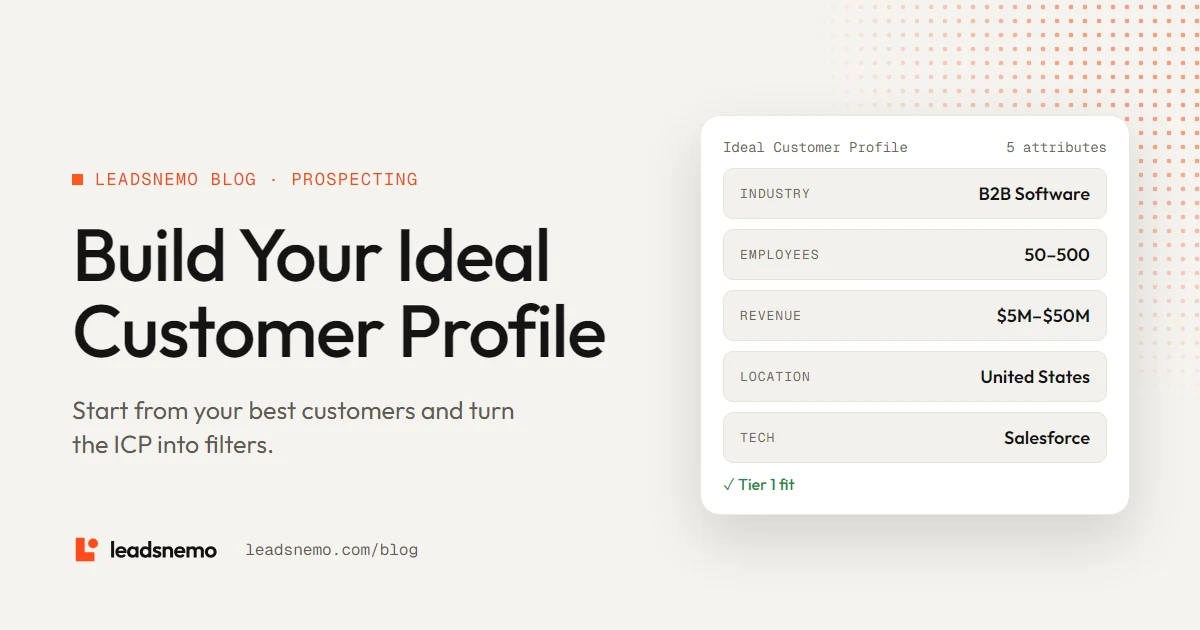
Each ICP attribute should map to a filter. If an attribute cannot be filtered, it will not shape your lists. The template above becomes this company search:
- Industry
- Computer Software, IT Services
- Employees
- 51–500
- Revenue
- $5M–$50M
- Location
- United States
- Technologies
- Salesforce
Company filters in LeadsNemo are free to use. You only spend credits when you reveal contact details.
From there, follow the steps in how to find B2B leads to add contacts, verify them and segment the list.
7. Review the ICP every quarter
Markets move, and so does your product. Once a quarter, rerun the top-customer review with the latest closed-won and churn data. Add a new industry when you win three or more deals in it. Drop an attribute when it stops separating winners from losers.
- Too broad: "Mid-sized companies in North America" leaves the list wide open. The U.S. alone has 8.0 million employer establishments, according to the 2022 Economic Census. Add industry and technology.
- Too narrow: Seven required attributes can leave you with 40 accounts. Move the weakest ones into the scoring tiers.
- Aspirational: Enterprise logos you have never closed belong on a stretch list, not in the ICP.
- Static: An ICP written two years ago reflects a product you no longer sell.
Conclusion
Build the ICP from customers who already buy and stay, keep it to attributes you can filter on, and write down what disqualifies an account. Score accounts into tiers so reps spend their time on the best fits, then revisit the profile every quarter as your customer base grows.
Frequently asked questions
What is an ideal customer profile in B2B?
An ideal customer profile (ICP) describes the type of company that gets the most value from your product and brings the most value back, usually defined by industry, employee count, revenue, location, technology and growth signals.
What is the difference between an ICP and a buyer persona?
An ICP describes the company you want to sell to. A buyer persona describes a person inside that company, such as a VP of Sales, including their goals and objections.
How many attributes should an ICP have?
Five to seven is a practical range. Fewer leaves the profile too broad to filter, and more usually leaves too few accounts to work.
How often should I update my ICP?
Review it once a quarter against your latest closed-won and churn data, and update it whenever an attribute stops separating good customers from poor ones.
Can I build an ICP without customer data?
Yes, as a hypothesis. Use pilot users, sales calls and lost deals, then revise the profile once you have 20 to 30 customers to compare.