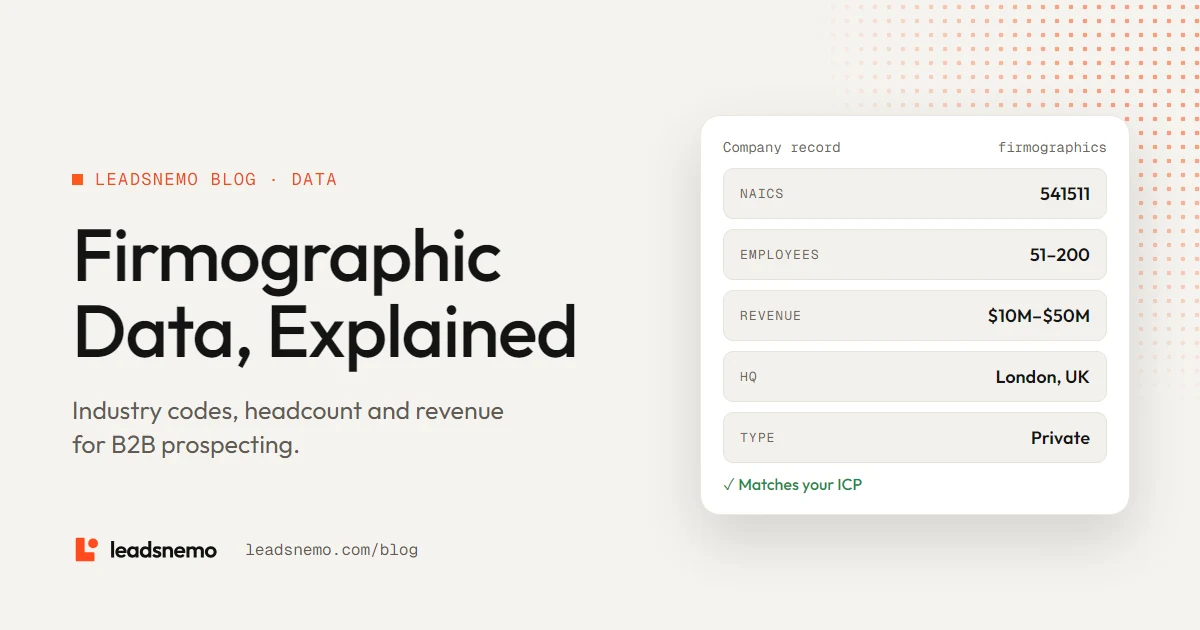
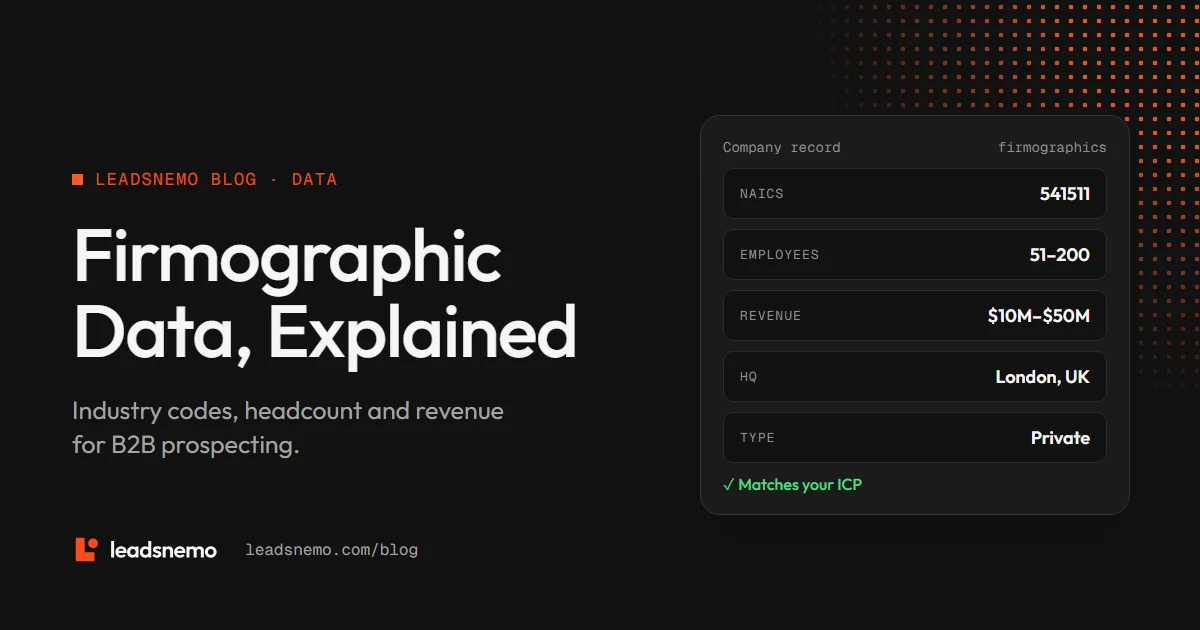
- Firmographics describe companies. Industry, employee count, revenue, location, company type and age are the core fields.
- Use industry codes, not labels. A six-digit NAICS code means the same thing in every data source.
- Treat revenue as an estimate. Private companies rarely publish revenue, so use it in bands and pair it with headcount.
- Firmographics decide fit, not timing. Combine them with technographic data and buying signals.
1. What is firmographic data?
Firmographic data is descriptive information about a business: what industry it works in, how many people it employs, how much revenue it makes, where it operates and how it is structured. It does for companies what demographic data does for people.
| Data type | Describes | Examples |
|---|---|---|
| Firmographic | The company | Industry, employee count, revenue, headquarters |
| Demographic | The person | Job title, department, seniority, location |
| Technographic | The company’s tools | CRM, cloud provider, marketing platform |
| Intent and signals | What is changing | Hiring, funding, leadership change, website visits |
In prospecting, firmographics answer the first question on any list: should this company be here at all? They are the backbone of an ideal customer profile.
2. The firmographic fields that matter
| Field | What it tells you | Watch out for |
|---|---|---|
| Industry | Which market the company serves | Free-text labels vary by source; prefer codes |
| Employee count | Company size and likely buying process | Ranges differ between sources and go stale after growth or layoffs |
| Revenue | Purchasing capacity | Estimated for most private companies |
| Location | Territory, time zone, regulation, language | Headquarters is not where every team sits |
| Company type | Public, private, nonprofit, government | Subsidiaries may buy through a parent |
| Founded year | Maturity and stage | Rebrands and mergers reset the date in some sources |
Employee count is usually the most useful single field. It is easier to measure than revenue and it predicts how a company buys: a 30-person firm often decides in one meeting, while a 3,000-person firm involves several departments. Check which level a source counts. In Census statistics an establishment is a single physical location, while a firm is made up of one or more establishments, so one company can show up as many locations.
3. How NAICS and SIC industry codes work
Two classification systems dominate U.S. business data. The North American Industry Classification System (NAICS) is the standard federal statistical agencies use to classify business establishments. It was adopted in 1997 to replace the Standard Industrial Classification (SIC) system, which is still common in older databases and filings. The OSHA SIC manual remains the easiest place to look up SIC codes.
NAICS codes are hierarchical. According to the Bureau of Economic Analysis, the first two digits designate the sector, the third the subsector, the fourth the industry group, the fifth the NAICS industry and the sixth the national industry. Each extra digit narrows the market.
- 54
- Sector: Professional, Scientific, and Technical Services
- 5415
- Industry group: Computer Systems Design and Related Services
- 541511
- National industry: Custom Computer Programming Services
For prospecting, filter at the four-digit level first. Two digits is too broad for most products, and six digits can split one market into several codes. Widen or narrow from there based on how many accounts you get back.
4. How to use firmographics in prospecting
- Define fit. Turn your best customers’ shared traits into firmographic ranges: industries, headcount band, revenue band, regions.
- Size the market. Run the filters and count the matching companies. If the number is far smaller than your pipeline target needs, loosen one filter at a time.
- Segment. Split the list by size or industry so each segment gets a message that fits. A 40-person agency and a 900-person manufacturer have different problems.
- Assign territories. Use location and headcount to give each rep a balanced set of accounts.
- Prioritize. Rank accounts by how closely they match, then add signals to decide timing.
- Industry
- Computer Software
- Employees
- 51–200
- Revenue
- $10M–$50M
- Location
- United Kingdom, Ireland
Search companies by industry, size, revenue and location in LeadsNemo for free. Credits are only used when you reveal contact details.
5. Where firmographic data goes wrong
- Revenue guesses. Private companies do not publish revenue, so most figures are modeled from headcount and industry. Use bands, never exact numbers, in your filters. For public companies, check revenue at the source: the SEC’s EDGAR APIs return financial statement data from filings such as the 10-K and 10-Q.
- Stale headcount. A company that doubled after a funding round still shows its old size in some sources. Check recent hiring before you rule an account out.
- Parent and subsidiary confusion. A subsidiary may show the parent’s revenue, or the parent may buy on its behalf. Decide which level you sell to.
- Multi-industry companies. A company has one primary code but may sell in several markets. Read the company description before you exclude it.
Firmographics tell you whether a company fits. They say nothing about timing or tooling. Add technographic data to check compatibility and buying signals to decide when to reach out.
Conclusion
Firmographic data is the first filter on every B2B list. Use standard industry codes, lean on employee count, treat revenue as a band and check the fields that change fastest. Then layer technographics and signals on top to decide which accounts to work first.
Frequently asked questions
What is firmographic data?
Firmographic data is descriptive information about a company, such as its industry, employee count, revenue, location, company type and founding year. B2B teams use it to decide which companies fit their product.
What is the difference between firmographic and demographic data?
Firmographic data describes a company. Demographic data describes a person, such as their job title, department or seniority.
Should I use NAICS or SIC codes?
Use NAICS where you can. It replaced SIC for U.S. federal statistics in 1997 and has more detail. Some databases and filings still use SIC, so it helps to know both.
How accurate is company revenue data?
For public companies it comes from filings. For private companies it is usually an estimate, so filter by revenue bands and pair them with employee count.