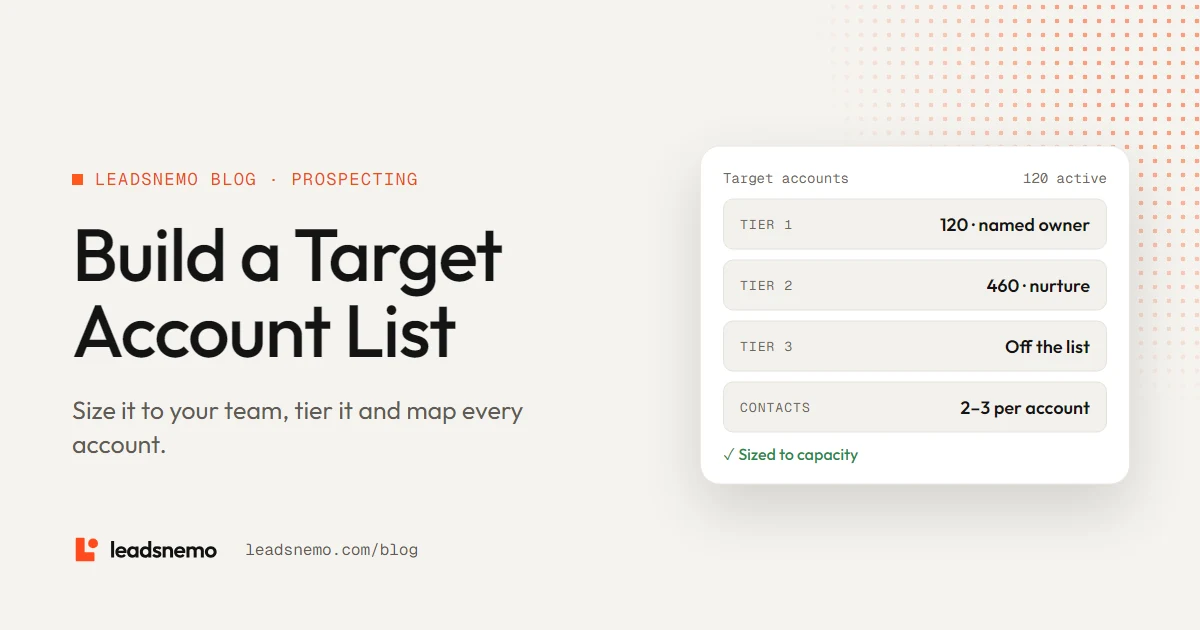
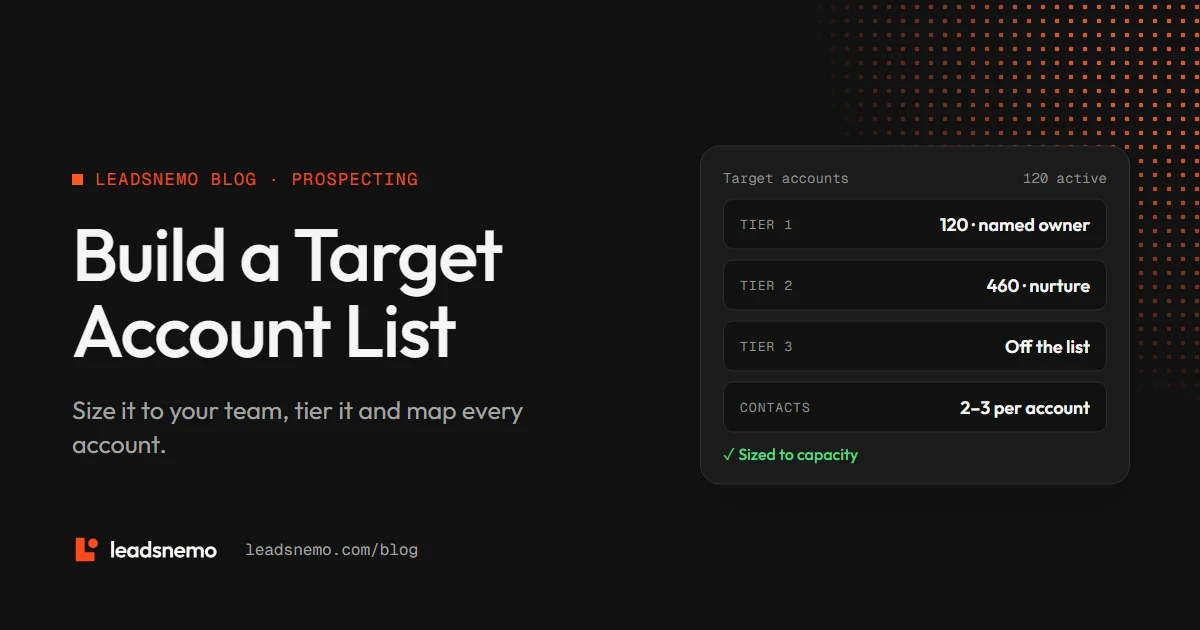
- Size the list to your capacity. Reps multiplied by the accounts each can work properly.
- Fill it from your ICP, then tier accounts by fit and signals.
- Remove exclusions such as customers, open deals and competitors before anyone starts outreach.
- Map two or three contacts per account and review the list every quarter.
1. What is a target account list?
A target account list (TAL) is a named list of companies that sales and marketing agree to pursue together. It is the starting point for account-based prospecting: instead of working whoever responds, the team chooses the accounts first and builds outreach around them. HubSpot, for example, has a target account property that marks the companies you are marketing and selling to as part of an account-based strategy.
| Lead list | Target account list | |
|---|---|---|
| Unit | People | Companies |
| Size | Hundreds to thousands of contacts | Dozens to a few hundred accounts |
| Chosen by | Filters and response | Fit, tier and agreement between sales and marketing |
| Outreach | Sequences to individuals | Coordinated outreach to several people per account |
2. Size the list to your team’s capacity
The most common mistake is a list too long to work. Start from capacity, not from the size of the market.
List size = reps × accounts each rep can actively work
An account rep doing researched, multi-contact outreach can usually handle a few dozen accounts at a time, not hundreds. If three reps can each work 40 accounts properly, the active list is 120. Keep a second, larger tier for marketing to warm up while reps work the first.
Focus pays off because buyers do much of their research alone. Gartner’s 2025 sales survey found that 61% of B2B buyers prefer a rep-free buying experience. A small list worked closely gives each rep time to make every contact relevant.
3. Build the list step by step
- Start from the ICP. Filter companies by the industries, size, revenue, location and technology in your ideal customer profile.
- Add accounts you already know. Include closed-lost deals worth another try, past customers and accounts that engaged with marketing.
- Remove exclusions. Take out current customers, open opportunities, competitors, partners and accounts under a do-not-contact rule. Business email gets no exemption: the FTC’s CAN-SPAM guide says the law makes no exception for business-to-business email, and opt-outs must be honored within 10 business days.
- Tier the accounts. Rank by fit and signals, then cut to your capacity number.
- Assign owners. Every Tier 1 account gets one named rep.
- Map the contacts. Find two or three people per account across the buying committee.
- ICP filter results
- 2,340 companies
- After exclusions
- 2,180
- Tier 1 (fit + signal)
- 120, assigned to 3 reps
- Tier 2 (fit, no signal)
- 460, marketing nurture
- Tier 3 (partial fit)
- Left off the active list
4. Tier accounts by fit and timing
| Tier | Criteria | Treatment |
|---|---|---|
| Tier 1 | Full ICP match plus a recent buying signal | Researched outreach to 2–3 contacts, named owner |
| Tier 2 | Full ICP match, no current signal | Lighter sequences and ads, monitor for signals |
| Tier 3 | Partial match | Marketing only, re-check each quarter |
Signals move accounts between tiers. A Tier 2 account that hires a new VP of Sales or raises funding should move up that week. B2B buying signals covers which events to watch.
5. Map contacts at each account
Account-based prospecting reaches several people at each company: a budget owner, someone who evaluates the product and someone who feels the problem every day. How to find decision-makers at a company explains how company size changes who those people are.
- Account
- Company C · B2B software · 300 employees
- Budget owner
- VP of Sales
- Evaluator
- Revenue Operations Manager
- Daily user
- SDR Team Lead
Filter companies by your ICP and map contacts at each account in LeadsNemo. Filtering is free; credits are only used to reveal contact details.
6. Keep the list current
- Review every quarter. Drop accounts that ruled themselves out and promote Tier 2 accounts with new signals.
- Re-check contacts before each push. People leave: in January 2026, 20.6% of U.S. wage and salary workers had been with their employer for a year or less, according to the BLS Employee Tenure Summary, and employers recorded 3.4 million quits in September 2026 alone (BLS JOLTS). See B2B data decay.
- Track coverage. Count how many Tier 1 accounts have at least two verified contacts and one recent touch.
- Share results with marketing. The list only works if both teams target the same accounts.
Conclusion
Size the target account list to what your team can work, fill it from your ICP and known accounts, remove exclusions and tier by fit and signals. Map two or three contacts per account and review the list every quarter so it keeps pointing at the companies most likely to buy.
Frequently asked questions
What is a target account list?
A target account list is a named list of companies that sales and marketing agree to pursue together, usually chosen by ICP fit and buying signals.
How many accounts should be on a target account list?
Size it to capacity: the number of reps multiplied by the accounts each can work with researched, multi-contact outreach, often a few dozen per rep.
What is the difference between a lead list and a target account list?
A lead list is a set of people to contact. A target account list is a set of companies chosen in advance, with several contacts reached at each.
How often should I update my target account list?
Review it every quarter, and move accounts between tiers whenever a buying signal appears.