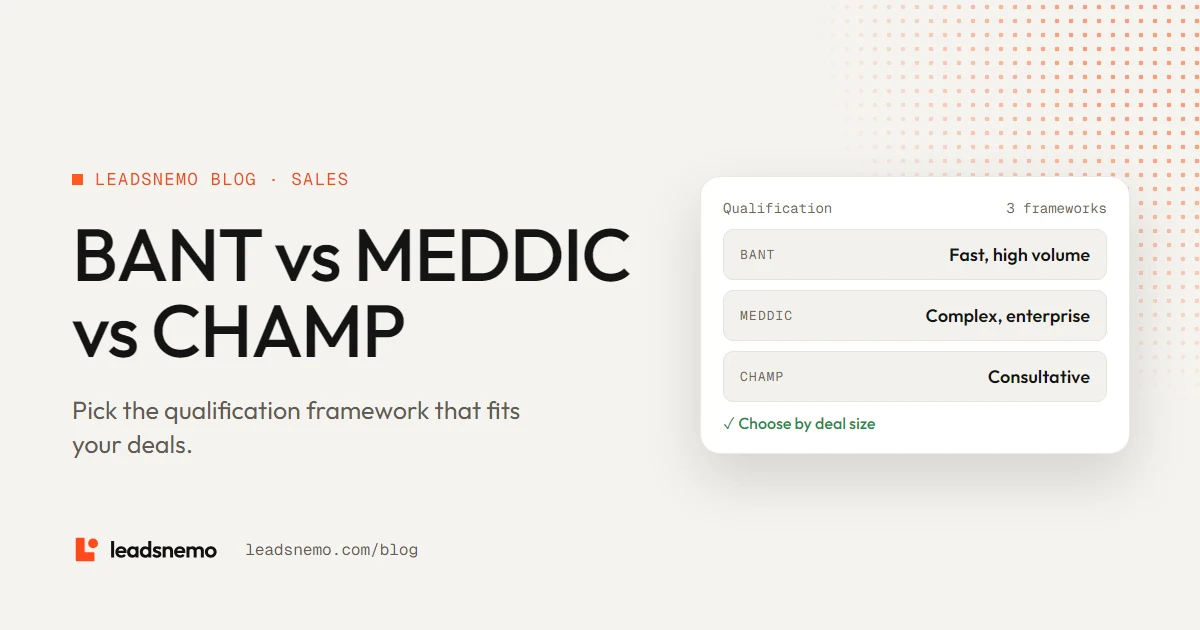
- BANT checks budget, authority, need and timeline. It is fast and suits high-volume, shorter sales.
- MEDDIC maps metrics, the economic buyer, decision criteria and process, pain and a champion. It suits complex enterprise deals.
- CHAMP leads with challenges and fits consultative sales where budget comes later.
- Pick by deal size and cycle length, then adapt the framework to your own sales history.
1. Why use a qualification framework?
A lead qualification framework is a fixed set of criteria a sales team uses to decide whether a prospect is worth pursuing and how far a deal has progressed. Without one, each rep uses their own judgment, forecasts drift and deals with no real buyer sit in the pipeline for months. A 2025 peer-reviewed study of B2B lead scoring calls lead prioritization a critical task because it lets organizations allocate resources more effectively.
Many teams track the first handoff with CRM lifecycle stages. HubSpot’s lifecycle stages separate a marketing qualified lead, which marketing has judged ready for sales, from a sales qualified lead, which sales has qualified as a potential customer.
Qualification starts before the first call. If the account fails your ideal customer profile, no framework will rescue the deal.
2. BANT: budget, authority, need, timeline
BANT is the oldest and simplest of the three. It asks four questions, usually on the first or second call.
| Letter | Criterion | Question to ask |
|---|---|---|
| B | Budget | Is money set aside for this, or would it need to be found? |
| A | Authority | Who else is involved in a decision like this? |
| N | Need | What happens if you do not solve this problem this year? |
| T | Timeline | When do you need a solution in place, and why then? |
Strengths: quick to learn and quick to apply. Weaknesses: it assumes the buyer already has a budget, and many good deals start before one exists. Asking about budget first can also end a promising conversation early.
3. MEDDIC: built for complex deals
MEDDIC was created in 1996 at PTC by Dick Dunkel, working under SVP John McMahon with Jack Napoli, according to MEDDICC’s history of the framework. It goes deeper than BANT and is common in enterprise software sales. Extended versions add letters for paper process and competition (MEDDPICC).
| Letter | Criterion | What you need to know |
|---|---|---|
| M | Metrics | The measurable result the buyer expects, such as hours saved or revenue gained |
| E | Economic buyer | The person who can approve the spend |
| D | Decision criteria | How the buyer will compare options |
| D | Decision process | The steps, people and dates between now and a signature |
| I | Identify pain | The business problem and its cost |
| C | Champion | An insider who sells for you when you are not in the room |
Strengths: forecasts become more reliable because every stage depends on evidence. Weaknesses: it takes several conversations to fill in, so it is too heavy for small, fast deals.
4. CHAMP: challenges first
CHAMP reorders BANT so the conversation starts with the buyer’s problem instead of their budget.
| Letter | Criterion | Question to ask |
|---|---|---|
| CH | Challenges | What is getting in the way of your goals right now? |
| A | Authority | Who owns this problem, and who signs off on a fix? |
| M | Money | How have you funded similar projects before? |
| P | Prioritization | Where does this sit against your other priorities this quarter? |
Strengths: fits consultative selling and feels less like an interrogation. Weaknesses: less structure than MEDDIC for long, multi-stakeholder deals.
5. Which framework fits your sales motion?
| BANT | MEDDIC | CHAMP | |
|---|---|---|---|
| Best for | High-volume, transactional sales | Enterprise, multi-stakeholder deals | Consultative, mid-market sales |
| Sales cycle | Days to weeks | Months | Weeks to months |
| Time to qualify | One call | Several meetings | One or two calls |
| Starts with | Budget | Metrics and pain | Challenges |
| Main risk | Drops deals with no budget yet | Too slow for small deals | Loose on process and paperwork |
Many teams combine them: BANT or CHAMP for SDR handoffs, MEDDIC for account executives on larger opportunities. Whatever you choose, write the exit criteria for each pipeline stage in the framework’s terms.
6. Use prospect data to qualify faster
Some criteria can be checked before the first call. Firmographic and contact data answer part of the framework in advance, so the call can focus on what only the buyer knows. That matters when buyers ration their time with sellers: Gartner’s 2025 sales survey found that 61% of B2B buyers prefer a rep-free buying experience. Job titles carry budget clues too: the BLS Occupational Outlook Handbook lists preparing budgets and approving expenditures among the duties of sales managers.
| Criterion | What data can tell you before the call |
|---|---|
| Budget or money | Employee count and revenue band suggest whether your price fits |
| Authority or economic buyer | Titles and seniority show who likely owns the budget |
| Need or pain | Tech stack and hiring show which problems are likely |
| Timeline | Signals such as new funding or a new leader suggest timing |
Use how to find decision-makers at a company to map authority before you call, and B2B buying signals to judge timing.
Filter people by department, seniority and title in LeadsNemo for free. Credits are only used to reveal contact details.
Conclusion
BANT suits short, high-volume sales, MEDDIC suits complex enterprise deals and CHAMP suits consultative selling that starts with the buyer’s problem. Choose by deal size and cycle length, define your pipeline stages in the framework’s terms and use prospect data to answer what you can before the first call.
Frequently asked questions
What does BANT stand for?
Budget, Authority, Need and Timeline. It is a quick framework for checking whether a prospect can and will buy.
What does MEDDIC stand for?
Metrics, Economic buyer, Decision criteria, Decision process, Identify pain and Champion. It was created at PTC in 1996 and is used mainly for complex enterprise deals.
What is the difference between BANT and CHAMP?
Both cover similar ground, but CHAMP starts with the buyer’s challenges and asks about money later, while BANT starts with budget.
Which lead qualification framework is best?
It depends on your sales motion. BANT fits fast, transactional sales, MEDDIC fits long multi-stakeholder deals and CHAMP fits consultative mid-market sales.